
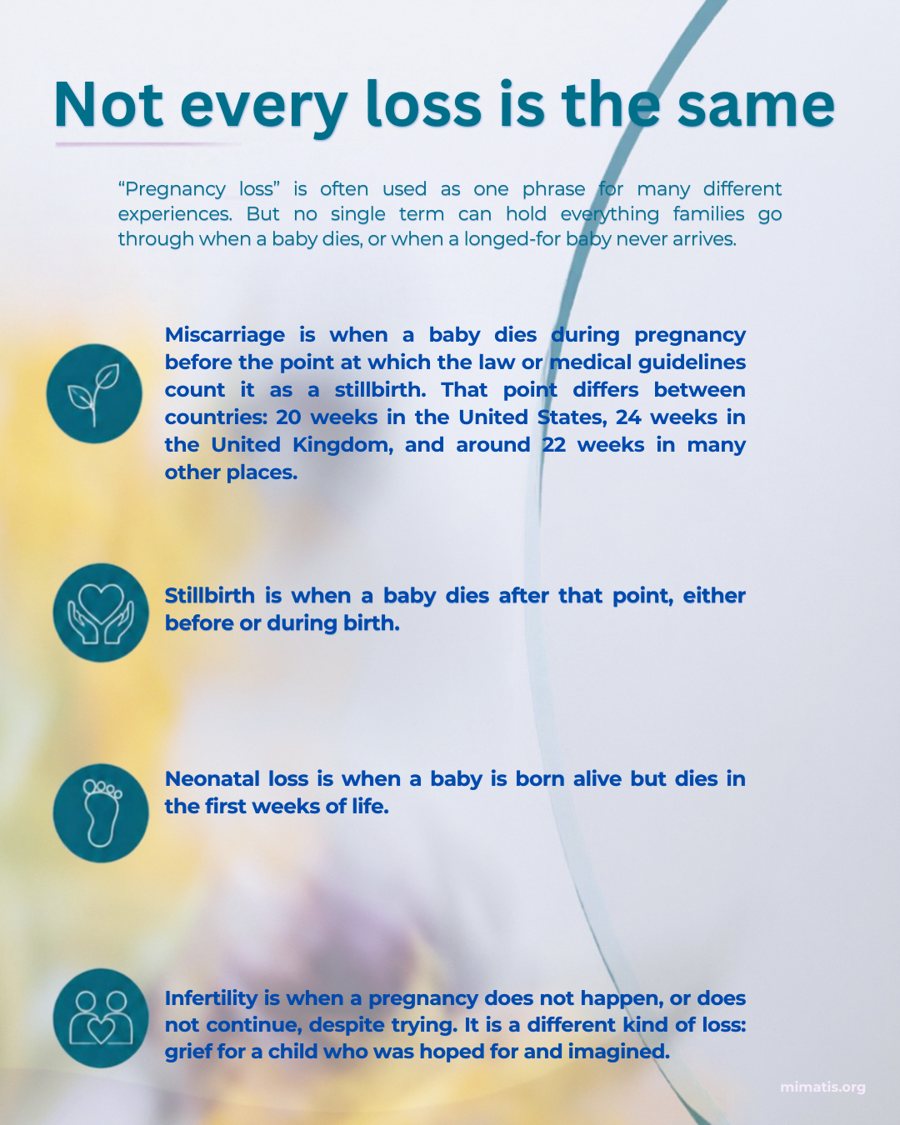
Ask a group of mothers, even mothers of several children, to explain what a stillbirth is. Many will hesitate. Some will say it is a very late miscarriage. Others will think it is something that happened in the past, or somewhere else. Very few will know that it happens to around 1.9 million babies a year worldwide, or that in some European countries several babies are stillborn every day.
This is not a failure of the people asked. It reflects how rarely these losses are named. Over the last decade, “pregnancy loss” has become the gentle, inclusive phrase used by charities, hospitals and the media, MIMATIS included. It has done real good. But it is worth asking whether one phrase can carry so many different experiences, and what is lost when it tries to.
What the words actually mean
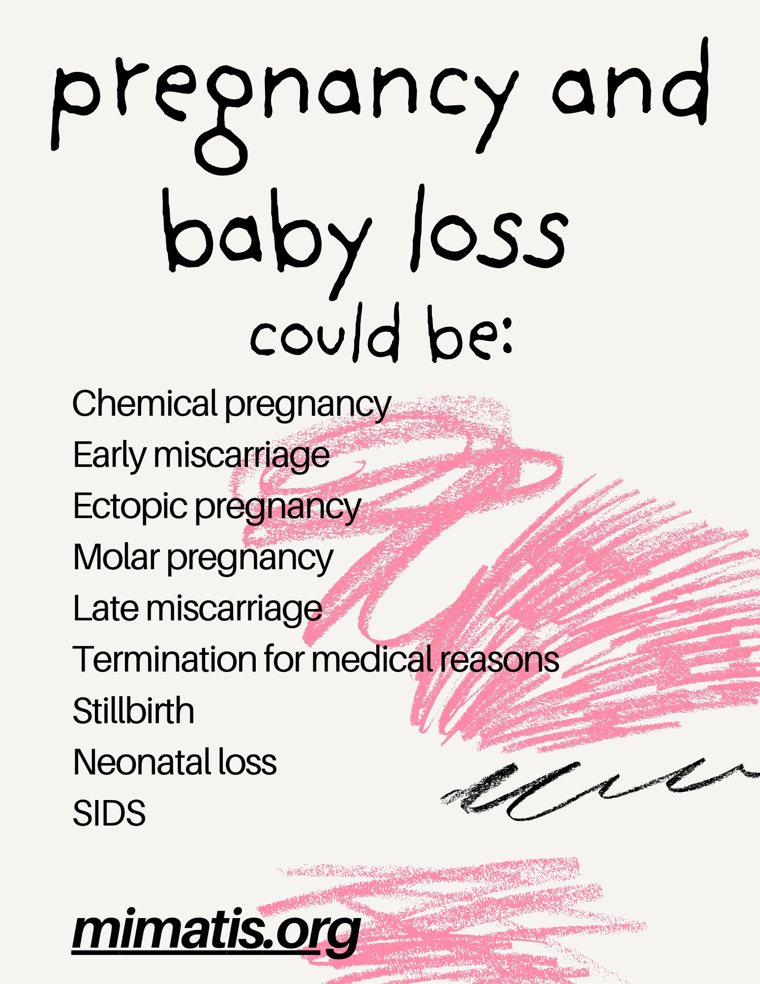
“Pregnancy loss” can describe any of the following. They differ in how far the pregnancy had come, what happens to the mother’s body, what parents are entitled to, and how others respond.
- Biochemical pregnancy (often called a chemical pregnancy): a pregnancy detected by a pregnancy test that ends before it can be seen on an ultrasound scan.
- Early miscarriage: the loss of a pregnancy in the first trimester, the most common form of loss.
- Ectopic pregnancy: a pregnancy that develops outside the womb, most often in a fallopian tube. It cannot continue and can be dangerous for the mother.
- Molar pregnancy: a rare condition in which the placenta does not develop normally, so the pregnancy cannot continue.
- Late miscarriage: a loss in the second trimester, before the point at which a country counts a stillbirth. Many mothers give birth to their baby.
- Termination for medical reasons: ending a wanted pregnancy after a serious diagnosis for the baby or a risk to the mother.
- Stillbirth: a baby who dies after that point, before or during birth. The mother goes through labour and birth, and her body responds as after any birth.
- Neonatal death: a baby who is born alive and dies in the first weeks of life.
- Sudden infant death: the sudden, unexplained death of a baby in the first year, often during sleep.
And then there is a loss that has no body to hold and no date to remember: infertility, the grief for a child who was hoped for and imagined, but never arrived.
The same baby, different words
Even the line between a miscarriage and a stillbirth is not fixed. It is drawn by law and by medical guidelines, and it moves from one country to the next. In the United States, Canada and Australia a baby who dies from 20 weeks is counted as stillborn. In the United Kingdom and Ireland the line is 24 weeks. Most countries in the European Union use 22 weeks, a few use 28, and Norway uses 12. For comparing countries, the World Health Organization uses 28 weeks.
In practice, this means a baby who died at 23 weeks could be counted as stillborn in France and as a late miscarriage in the United Kingdom. For the parents, the baby, the labour and the grief are the same. What changes is whether the birth is registered, whether a funeral is required, and what leave a mother is entitled to. Our country guides for Spain, France and Austria show how differently these lines are drawn, even between neighbours.
A baby who died at 23 weeks could be stillborn in France and a late miscarriage in the United Kingdom.
What people actually know
Research suggests the gap in understanding is wide:
- In a national survey of 999 adults in Ireland, only 17% knew how common stillbirth is, and 56% could not name a single risk factor.
- In an Australian survey of 344 people, most of them women, only 25% knew that around six babies are stillborn in Australia every day. A third believed that babies move less late in pregnancy because they run out of room, a myth that can delay care.
- In a survey of over 1,000 adults in the United States, 55% believed miscarriage is uncommon, happening in fewer than 6% of pregnancies. A 2021 Lancet review puts it at around 15% of recognised pregnancies, about 23 million a year worldwide.
- In the United Kingdom, a 2023 survey found that half of all adults had been affected by pregnancy or baby loss, themselves or through someone close to them.
So these losses are common, and they touch most families, yet many people do not know what they are, how often they happen, or what can be done.
Does “pregnancy loss” help or hide?
The umbrella term has helped in important ways. It replaced harsh clinical language: a European consensus of specialists in 2015 recommended “pregnancy loss” and “miscarriage” instead of “spontaneous abortion”, noting that patients prefer these words. It gives everyone a shared place to stand, so that a woman after an early miscarriage and a family after a stillbirth can both feel included in a remembrance day or a support group. And it is easier to say out loud.
But a single phrase can also blur what is different. After a stillbirth, a mother has given birth. Her milk may come in. There may be a funeral, a name on a register, a birth certificate or none at all. “We lost the pregnancy” can sound, to a parent who held their baby, as if the baby is missing from the sentence. The writer Rebecca Little described in STAT how, after her own losses, no available term seemed to fit, and how that left her and many others without words for what had happened.
Vague language also has practical costs. If people do not know that stillbirth exists, they do not know to ask about it. If they believe babies naturally move less before birth, they may wait when they should call. If friends and employers think every loss is “early”, they may expect a mother back at work in days, when she has just given birth.
So, should we speak about it more?
Yes, and more precisely. Not to rank losses, because grief is not measured in weeks, but so that each one can be recognised for what it was. That can start with small things:
- Use the words parents use. If a mother says her son was stillborn, say stillborn. If she says her baby, say baby. If she uses a name, use the name.
- Know the signs. Maternity services advise pregnant women to contact their maternity unit straight away if their baby’s movements slow down, stop or change, and not to wait until the next day.
- Learn what the words mean. Knowing the difference between a miscarriage, a stillbirth and a neonatal death helps families, friends and colleagues respond with the right care.
- Talk about it outside of loss. In antenatal classes, in schools, at work. Information is easier to hear before it is needed.
“Pregnancy loss” opened the door to talking. The next step is to say clearly what happened, and to name the babies it happened to.
Nuzum et al., The public awareness of stillbirth: an Irish population study, BJOG 2018 · Pollock et al., Knowing your audience: stillbirth knowledge in Australia, Women and Birth 2022 · Bardos et al., A national survey on public perceptions of miscarriage, Obstetrics & Gynecology 2015 · Quenby et al., Miscarriage matters, The Lancet 2021 · Tommy’s and partner charities, Baby Loss Awareness Week survey 2023 · Pregnancy Loss Research Group, UCC, The definition of stillbirth: a rationale for change, 2021 · Kolte et al., Terminology for pregnancy loss prior to viability (ESHRE), Human Reproduction 2015 · Rebecca Little, The inadequate language of pregnancy loss, STAT 2024 · UNICEF Data, stillbirth estimates 2023