Photo: Homester Interieur en Styling
Many parents want something to hold on to in the first days after their baby dies: time, care, and things made with love. That is why MIMATIS brings artists and makers into the Journal, people whose work is made for families after the loss of a baby. This is not advertising. We share what we find truly beautiful, so that parents know it exists.
Janine van Veen runs Sterrenkindje (“star child”) in Nijkerk, in the Netherlands. She makes carrying baskets, small caskets and memory stars for babies and children who have died. She is a nurse, trained in grief and bereavement support, and she is the mother of Jonas. She answered our questions in Dutch; this is our translation, lightly shortened.
Jonas, and how Sterrenkindje began
“On 6 December 2011 I was tidying the house before my check-up with the midwife, looking for a verse for the birth announcement. Half an hour later my world stood still. I was 37 weeks pregnant, and the midwife could not find a heartbeat. Two days later my son Jonas was stillborn.
Jonas came home with us; I never doubted that for a moment. He was my most beautiful baby. I was proud of him, loved him unconditionally and felt like his mother. He lay in our family cradle, the one my father made for me. In many ways my week after the birth was no different from the weeks with my other children. Of course I cried, but I was also simply a mother. I held him and cared for him, and at night I went to check on him and change his cooling packs. Every morning I gave him a clean wrap. Not because he needed it, but because my mother’s heart told me to.
After his death I felt like an invisible mother. The world kept turning while mine had changed for ever. My raw grief has changed over the years, but my love for him and my pride in him have stayed. He is my eldest son and always will be.
Without Jonas, Sterrenkindje would never have come into my life in 2017. In 2018 I took over the business. I saw a way to bring together my background as a nurse, my training in grief and loss support, my creativity and my experience as a mother. Above all, I saw a way to give meaning to my love for Jonas.”
“Parents are not only parents once their baby comes home alive.”
“I believe we should not only see a baby who has died as a child we must say goodbye to. Above all, it is a child who is welcome, who is loved, whom parents have dreamed of and want to care for.
I know it can feel almost cruel to encourage parents to meet their baby, to feel love and bond, when they then have to let go. But that meeting, the time together and being able to care for your baby mean so much. Every baby who has died deserves a welcome, everywhere in the world. Being able to meet and care for your baby should not depend on the hospital where you give birth or the country you live in.”
What she wished she had had
“When a baby is born, there are rituals, congratulations and, in the Netherlands, rusks with sugared aniseed. With Jonas, they were missing. I mostly received cards saying ‘strength’ and ‘condolences’. Of course I was sad, but I had also become a mother. What I would have loved most was to sit at the sewing machine myself and, with my own mother, sew the fabrics for his basket.
For other parents, I wish for attention to the birth of their son or daughter, not only to their baby’s death. I hope they can welcome their child, care for their baby themselves and make memories together, making the choices that fit them, without others deciding for them what is right.”
Why a basket?
“A basket is not the obvious choice for every parent. One parent thinks of picnics; another does not want a coffin, which feels hard and heavy. We all have our own feelings about materials, shapes and words. I prefer to call it a carrying basket, which sounds softer and more loving.
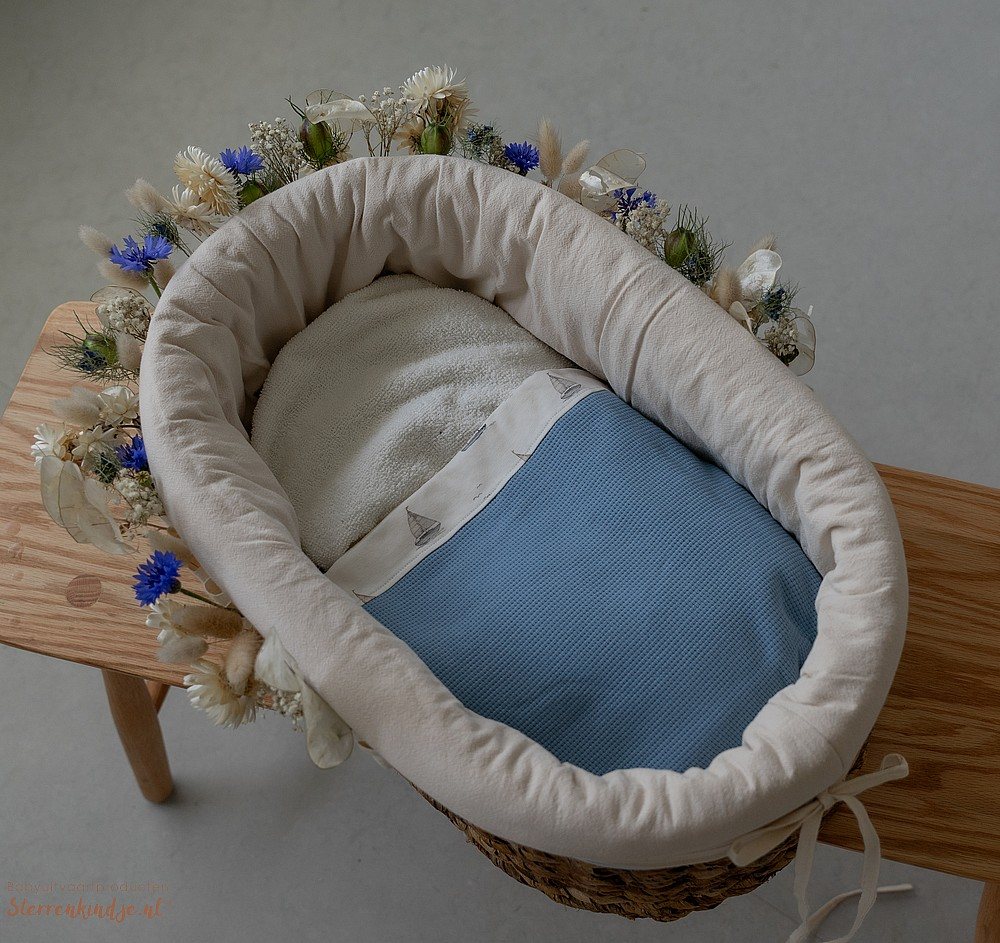
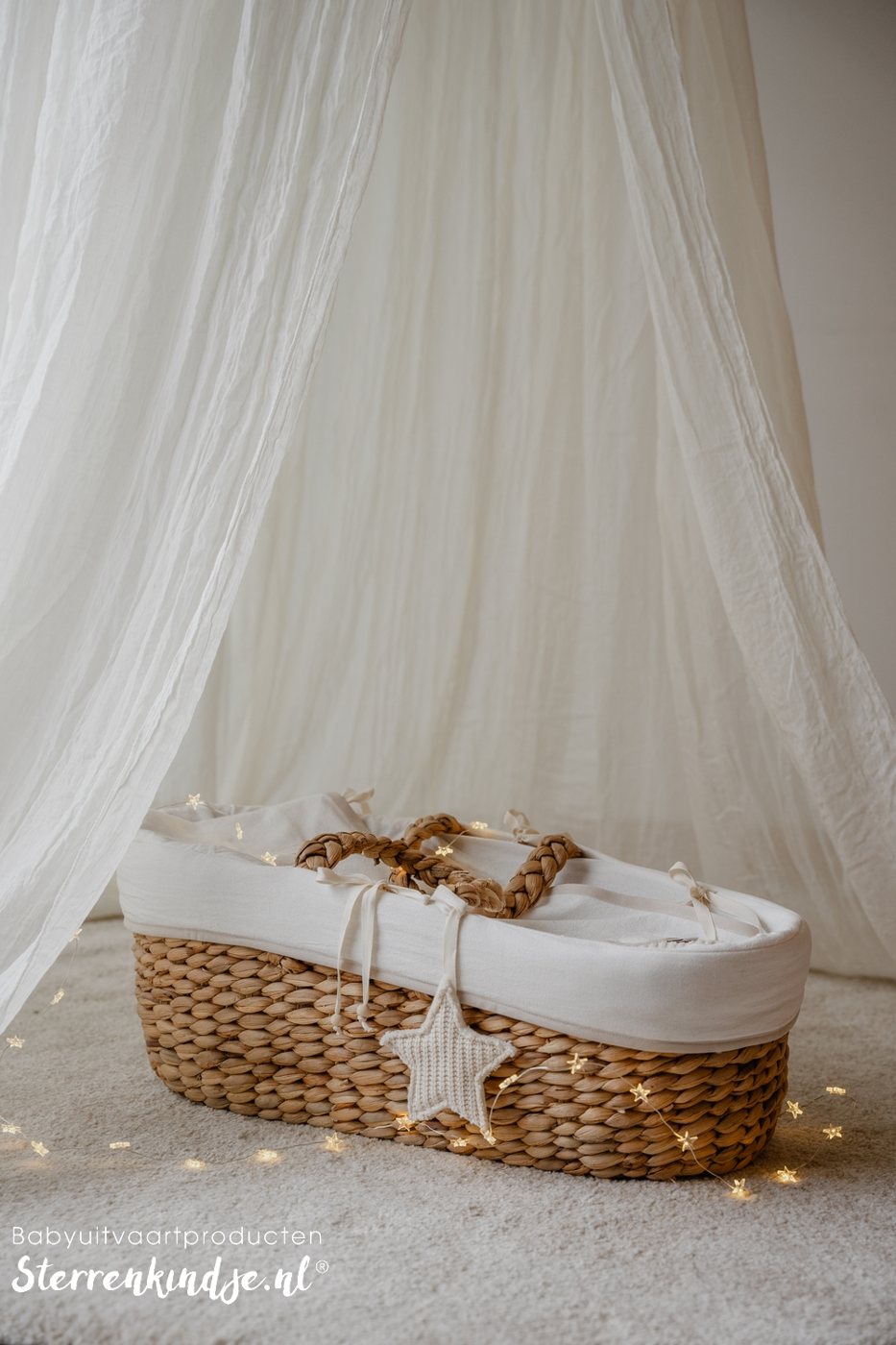
Sterrenkindje carrying baskets are made with care in Indonesia from natural materials. They are sturdy because of the woven structure, and the round shape feels gentle, even when you carry the basket with your baby in your arms.
A carrying basket is most like a portable, woven cradle. You can use it to bring your baby to the funeral home, but also, and especially, at home. Parents can easily move their baby from the bedroom to the living room, put the basket next to them on the sofa, or keep their baby close in bed. They look at their baby, touch them, lift them out to hold them and lay them back again. These may be small, ordinary acts, but they are part of being a parent. Even when your baby has died. Perhaps especially then.”
Fabrics, softness and two memory stars
“The fabrics are chosen carefully for their softness, print, comfort and consolation, and with care for the environment. For me, softness is more than the fabric. When life hurts more than you ever thought possible, softness matters: in the colours, the materials and the touch.
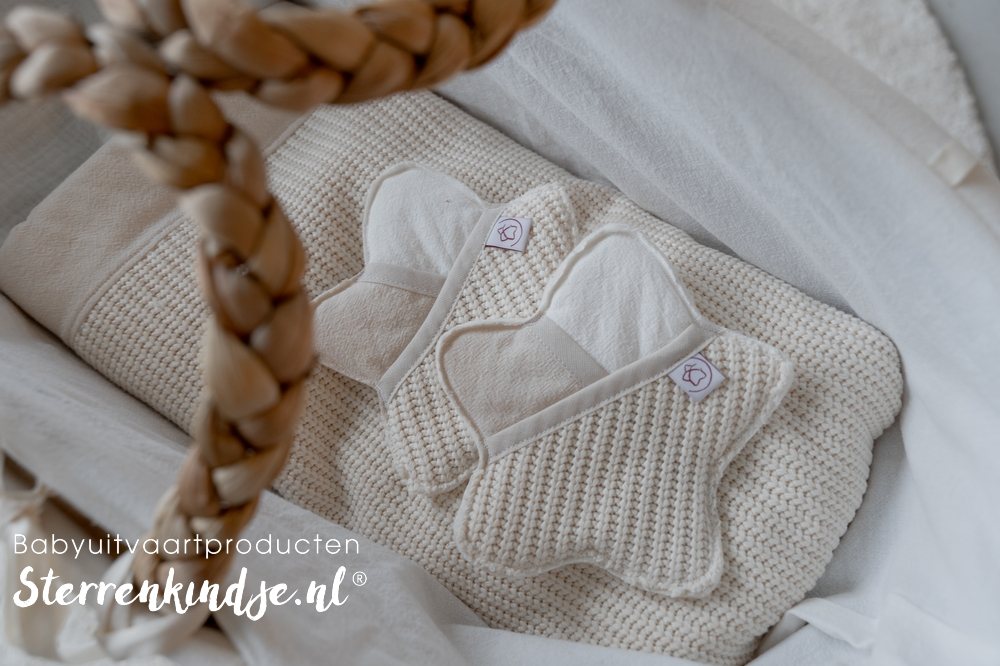
The memory stars are made from the same fabrics as the basket or casket. One star is laid with the baby to create a scent memory. On the day of the funeral, parents swap the stars, so that afterwards they have a star that smells of their baby. Parents often use a star to send a kiss, a poem or a drawing with their baby. Later, many parents like to feel the fabric of the lining again and remember how soft it was. For brothers and sisters, the stars can be precious keepsakes too.
A small star made from the same fabric as the blanket also hangs on the handle of every basket or casket. It can stay with the basket or go home with the parents. Sometimes it is given a name. Parents can also order more stars, for brothers and sisters, grandparents or other loved ones.”
Two collections, the same care
“Sterrenkindje Puur is a carefully curated collection in soft, gender-neutral fabrics in the colours sand and pebble. Parents choose a basket or small casket with a fixed combination of fabrics. That helps when there is little time, or when parents cannot or do not want to make many choices. Puur is in stock and can be sent or collected the same day.
With Sterrenkindje Maatwerk (made to measure), parents choose the fabrics, colours and details themselves, and I guide them. They can also bring their own fabric with a personal meaning, such as a blanket or a sheet. Before I start, parents receive a photo of the chosen fabrics for approval, and while it is being made, we stay in touch by phone, WhatsApp or email, with photos. Depending on the basket and the details, it is ready within 24 to 48 hours. For orders abroad, we look at the options for each order.”
Products and grief support, together
“The two are closely woven together in my daily work. Whenever I am in contact with parents, I try not only to help them choose, but also to keep an eye on what they are going through. I listen, ask questions and explain what is possible, without deciding for parents what is right for them. I think it matters that parents know what is possible, so that they do not discover later that there were choices they would have liked to make.
For me, it is about parents feeling seen and taken seriously, as the parents of a child they love. The products are a means, not a goal in themselves. I cannot take away the loss. But I can help make room for the parenthood, the love and the memories that stay.”
What parents tell her years later
“Sometimes parents tell me years later how much the basket means to them. A father once said to me: ‘Janine, this isn’t a basket. It’s a nursery for ever.’ I have never forgotten those words. One mother told me her baby lay so calmly and peacefully under the blanket that, for the first time, she dared to take the time to look at him for a long while. Another told me that, thanks to the basket, her baby could come home.
Recently a mother wrote to me that meeting me, and what I had meant to them, had been one of the high points of the week her daughter was born. It confirms that it is not only about the product I make, but about the attention and the personal contact.”
For hospital staff and funeral directors
“Dutch midwives talk about the golden hour: the first hour after birth, when parents and their baby are quietly together and begin to bond. When a baby is stillborn, parents deserve that time too. It may be the most precious moment of the far too short time they have together.
Give parents the peace and space to meet their baby, to look at them, hold them and welcome them. Tell them what is possible, because in those first hours parents often do not know which choices they have: photographs, hand and foot prints, caring for their baby themselves. These first moments cannot be lived again. There is no ‘later’ to take photographs. Help parents to spend that time in their own way, without deciding for them what they can or cannot cope with.”
Taking your baby home
In the Netherlands, many parents take their baby home before the funeral. Rules on this differ between countries, so ask your hospital and funeral home what is possible where you live.
“Bringing your baby home is a possibility, if circumstances allow. It is not an obligation, and it is not the right choice for everyone. Some parents long to be at home with their baby; others feel better in the hospital or at the funeral home. At home, parents can keep their baby close in familiar surroundings, look at them, touch them and care for them.
You do not have to know everything in advance or arrange everything perfectly, and you do not have to know straight away what you want. Parents may change their minds. What I would most like to say is that a baby who has died does not automatically have to go straight to a funeral home. Where circumstances allow, there can be room for more time together, in the place where parents feel at home.”
To a parent reading this today
“Your time with your baby is more than precious. You have just given birth to your baby. You still have to take in what has happened, full of disbelief, grief and pride, while at the same time you are asked to make all kinds of decisions. You do not have to know straight away what you want or what you can cope with.
Ask what the options are. Can your baby come home? Will you care for your baby yourself? How will you spend your time together, in your own way? I wish you the time to get to know your baby, to hold them, look at them and care for them. To discover who your baby looks like, to marvel at those small hands and feet, and to make memories. Not because you have to do all of this, but because you cannot live those moments again.
Your baby deserves a welcome. And you deserve the time and space to welcome your baby, in a way that fits you. To be a mother, to be a father, to be together for a short while.”
Your health and safety come first: follow your medical team’s advice, and ask them what is possible for you and your baby.
About Janine and Sterrenkindje
Before taking over Sterrenkindje in 2018, Janine completed postgraduate training in grief and bereavement support. With Judith Derks, she researched parents’ need for psychosocial support three to four years after a perinatal loss; the article was published in the Dutch professional magazine Nataal in 2017 (in Dutch).
Sterrenkindje also works with hospitals in the Netherlands: some keep a basket on the ward, so that staff can carry a baby to the mortuary calmly and with dignity. You can find Janine’s work at sterrenkindje.nl (in Dutch). More makers are in our Makers section.
Photos: Homester Interieur en Styling, for Sterrenkindje. Thank you to Janine for her answers and for sharing Jonas’s story.