A place for your baby’s name
The MIMATIS memorial garden is a quiet online garden for babies who died during pregnancy, at birth or soon after. Plant a flower in your baby’s name. It blooms alongside flowers planted by parents around the world, and it stays there, always.
For every baby, at any time
After a miscarriage, a stillbirth, the death of a newborn or a termination for medical reasons, many parents look for somewhere to say their baby’s name. Some parents have no grave to visit, and few people ever met their baby. The garden is one small place where your baby is remembered.
You can plant a flower in the first days after your loss, or many years later. There is no wrong time.
Why we look for ways to remember
For a long time, grieving people were told that healthy grief meant letting go and moving on. In 1996, the researchers Dennis Klass, Phyllis Silverman and Steven Nickman challenged that view in their book Continuing Bonds: New Understandings of Grief. Studying bereaved parents and other families, they described keeping a bond with the person who died as a normal part of grieving, one that continues and changes over time.
Klass had seen it in a group of parents whose children had died: they went on including their children in their lives and in their family stories. Many parents of babies do the same. They say their baby’s name, mark the due date and the birthday, light a candle, or keep a small box of memories.
When a baby dies before or soon after birth, there is often very little to hold: few photos, few people who met the baby, sometimes no grave. That is why a place, a ritual or a flower can matter so much. It gives love somewhere to go, and it shows that your baby was here and is not forgotten.
How to plant a flower
- Write your baby’s nameThe name you gave, or a name you choose now.
- Choose a flowerThere are eight to choose from.
- Add the year, if you wishThen plant. Your flower appears in the garden.
The flowers: Cherry blossom, tulip, daisy, hibiscus, bouquet, sunflower, rose and lotus.
We keep only your baby’s name, the flower and, if you add it, the year. No account, no email and no other personal details. The flowers and names can be seen by everyone who visits the garden.
The meaning of flowers
Flowers have been part of remembering for a very long time. They can be laid on a grave, set on an altar or a windowsill, planted in a garden, or pressed between the pages of a book. Some carry a meaning that many families recognise.
Cherry blossom
In Japan, cherry blossoms flower for only a short time before the petals fall. They are closely linked to mono no aware, a gentle awareness that beautiful things do not last, and are seen as a picture of how short and precious life is.
Lotus
The lotus is rooted in the mud at the bottom of a pond, yet it opens above the water, clean and untouched. In Buddhism it is one of the most important symbols: purity, and something beautiful rising out of a dark place.
Forget-me-not
A small blue wildflower that carries its meaning in its name. In Britain it has become a quiet symbol for babies who died, and has given its name to a memorial garden for babies in Hemel Hempstead.
Poppy
A flower of remembrance for more than a century. Poppies drop their own seed, so where they have flowered once, they often come back. That is why MIMATIS seed letters are made with poppy seeds.
White flowers
In Mexico, on the altars built for children during Día de Muertos, white flowers come first: the colour of purity and innocence, for the smallest souls.
Rosemary
Not a flower, but an old plant of remembrance. “There’s rosemary, that’s for remembrance,” says Ophelia in Shakespeare’s Hamlet. It stays green all year and grows well in a pot.
A flower of your own
There is no right flower. Many parents choose one that connects to their baby: a flower that blooms in the month their baby was born, a flower in their baby’s name, the colour they had imagined, or flowers from the funeral that they pressed and kept. Whatever you choose in the garden, it is your baby’s flower.
Read more about how cultures around the world remember babies with flowers in Flowers that remember.
A flower you can plant at home
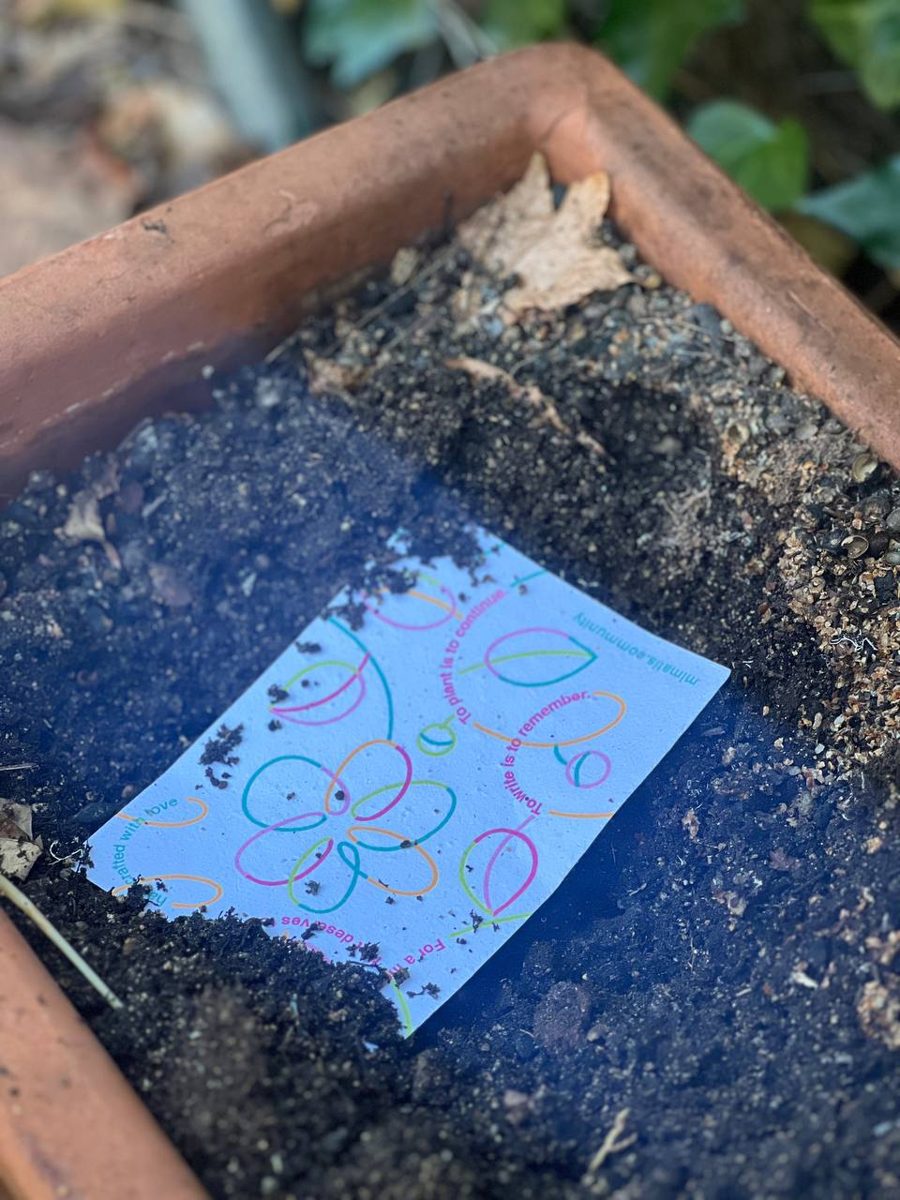
MIMATIS seed letters are made of paper with poppy seeds inside. Write to your baby, plant the letter in a pot or a garden, and in time the words become flowers that can return every year.
It is a gentle activity for brothers and sisters too: they can write, or draw what they feel, and plant it together with you.
Read more in Seed letters and Flowers that remember. Would you like seed letters for your family or your hospital? Write to contact@mimatis.org.
15 October, a day to remember together
15 October is Pregnancy and Infant Loss Remembrance Day. Many families light a candle at 7 pm. Read how countries mark the day in 15 October: how Europe remembers, or find a remembrance event near you on our events page.
Questions about the garden
Can I plant a flower after a miscarriage?
Yes. The garden is for every baby who died during pregnancy, at birth or soon after: after a miscarriage, a stillbirth, the death of a newborn, or a termination for medical reasons.
Can I plant a flower for a baby who died many years ago?
Yes. It is never too late to remember your baby. Adding the year is optional.
Does it cost anything, and do I need an account?
No. Planting a flower is free, and you do not need an account or an email address.
What do you keep, and who can see it?
We keep only your baby’s name, the flower you choose and, if you add it, the year. The flowers and names can be seen by everyone who visits the garden.
Which flower should I choose?
There is no right flower. Some parents choose a flower with a meaning, such as cherry blossom for a short, precious life, or lotus for something beautiful rising from a dark place. Others choose a flower that blooms in their baby’s month, or simply the one they like most.
What are seed letters?
MIMATIS seed letters are made of paper with poppy seeds inside. You write to your baby, plant the letter in a pot or a garden, and in time the words become flowers.
Sources
(6)
- Klass, Silverman and Nickman (eds.), Continuing Bonds: New Understandings of Grief, Taylor & Francis, 1996
- Wikipedia, Continuing bonds (Klass’s study of a self-help group of bereaved parents)
- Japan Journal, The Ah-ness of It All: cherry blossoms and mono no aware
- Carl Olson, The lotus as symbol (Buddhist University)
- Buddhistdoor Global, the lotus in Buddhism
- MIMATIS Journal, Flowers that remember (forget-me-not, poppy, white flowers, rosemary, with sources)
Your baby is remembered here
If you need practical help after your loss, our country guides explain your rights and where to find support, country by country.
Plant a flower